The Voltron Store has opened pre-orders for an exclusive “Go Together” T-shirt. Proceeds from sales of the shirt will benefit Heart to Heart International, a 501(c)3 organization founded in 1992.
Here is Heart to Heart International’s mission statement, from the group’s website:
Heart to Heart International strengthens communities through improving health access, providing humanitarian development and administering crisis relief worldwide. We engage volunteers, collaborate with partners and deploy resources to achieve this mission.
Only 2% of the organization’s funding is spent on fundraising and general administration. 92% goes to international health initiatives, and 6% goes to projects in the United States.
One of many elements that distinguish Voltron Force from other iterations of our favorite Defender of the Universe is the Nexus. It’s kind of cool, but it’a also kind of confusing.
What Is the Nexus?
We first see the Nexus at the end of the feature-length premiere, “The New Defenders Trilogy.” In other markets, this feature aired as three regular-length episodes, and in that context we first see the Nexus in the third episode, “Defenders of the Universe.”
After the five Lions take a pounding from a Haggarium-powered Robeast, the Voltron Force decides that they’re ready to form Voltron. Keith gives the classic “Activate interlocks” preamble, and the Lions connect as Keith orders them to “form feet and legs” and “form arms and body.” Just before Voltron’s head is formed, there is a quick cutaway shot.
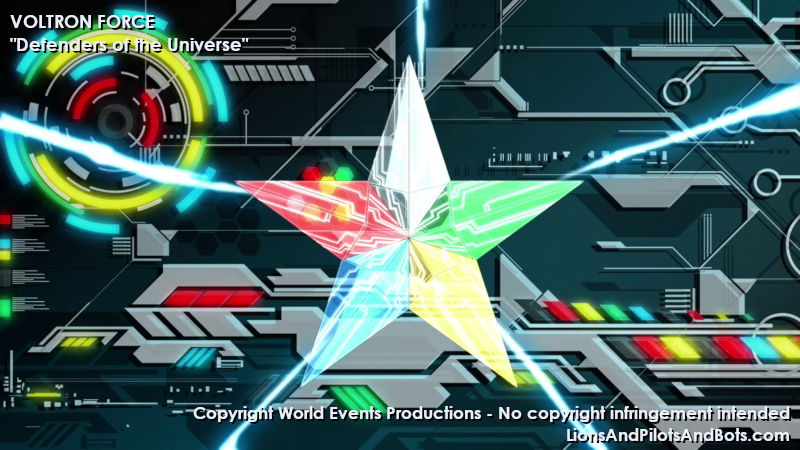
The star is a nod to Voltron: Defender of the Universe. In that program, inside each Lion’s cockpit, just above the slot in which the pilot inserts the Lion’s key, a display panel features a star comprised of six lights. The panel becomes visible and lights up just after the pilot inserts the Lion’s key, and when the pilot goes through the “Activate interlocks” routine in preparation to form Voltron.
The Lion cockpits in Voltron: The Third Dimension have a similar display panel.
The Stealth Lion cockpits in Voltron: The Third Dimension have a star-shaped display on a flat, touchscreen interface.
In Voltron Force, once the star is formed, the person in the “center Lion” tells everyone that he or she will form Voltron’s head.
This star is the Nexus — although this and other information about the Nexus aren’t revealed until the 13th episode, “Clash of the Lions,” which we’ll get to later.
The star is shown each time Voltron is formed using the “standard formation sequence.” We’ll probably explore the other formation sequence, “Flash Form,” in a future article.
The positions of the five “Nexus pieces” match the positions of the Lions when they are combined as Voltron, when viewed from the front. The upward point corresponds to the “center” Lion — the one that forms Voltron’s head and body. The upper left point and upper right point represent the “right arm Lion” and “left arm Lion,” respectively. The lower left point and lower right point represent the “right leg Lion” and “left leg Lion,” respectively.
Black Center
Red Center
Green Center
Blue Center
Yellow Center
In “Hungry for Voltron,” Blue Lion is separated from the others by a planetary force field, and the other four Lions are forced to form Voltron with a missing right leg. Correspondingly, the Nexus has only four of its five pieces. In the episode we see a four-Lion Voltron in both Black Center and Yellow Center configurations. We’re treated to a four-piece Black Center configuration of the Nexus. We aren’t shown the four-piece Yellow Center configuration of the Nexus, but we can assume it happens off-screen.
Four-Lion Voltron (Black Center)
Four-Lion Voltron (Yellow Center)
The episode “Clash of the Lions” finally reveals more about the Nexus. Sky Marshall Wade fires a Corite charge at the center of Voltron’s chest.
After Voltron is returned to the Castle of Lions, Pidge assesses the damage to the robot.
PIDGE
The Corite pierced something inside Voltron that we’ve never been able to crack before. The Lions each have one in their chest – like a heart-slash-hard drive – and they all come together when Voltron forms.
VINCE
Kinda like a Nexus!
PIDGE
Hmmm. Yeah. A Nexus. That’s exactly what it is. And now that there’s a hole in the Black Lion’s piece of the…Nexus, it’s releasing all kinds of strange data, things I can’t even begin to decipher. Whatever it is, access to this Nexus could change the entire way Voltron works.
In “Inside the Music,” Pidge explains more about his attempts to decipher the aforementioned “strange data.”
PIDGE
The hole Wade shot in the Black Lion’s piece of the Nexus has given me access to copious amounts of new data…but it all seems to be encrypted with some code so ancient, it’s…it’s almost like I need to create a new branch of science to understand it.
Later in the episode, Voltron battles a Robeast that can fire blasts of “Sonic Haggarium.”
KEITH
It’s like Haggarium is leaching in!
PIDGE
It must be penetrating the Nexus through that hole!
In “Rogue Trip,” in the hangar in the Castle of Lions, Pidge takes his research a bit too far.
PIDGE
I’ve been studying the Black Lion’s Nexus relentlessly, but I still can’t decipher the code. It’s based on ancient, but highly advanced, mathematical algorithm. If I’m going to have any hope of making progress, I’ll need to extract the Nexus and analyze it in the control room. Can you help me do some heavy metal surgery?
Hunk uses what looks like a blowtorch and cuts into Black Lion, but mere inches from the Nexus, Black Lion activates, roars, shakes Pidge and Hunk loose, and exits the hangar of the Castle of Lions.
The Voltron Force soon discusses Black Lion’s departure.
PIDGE
It’s as if Black sensed the Nexus was being threatened, and it triggered some kind of security response.
KEITH
But the Lions bond with their pilots, so how could they possibly consider us a threat?
PIDGE
I don’t know. But one thing is certain — the Nexus modules are far more important to Voltron than I ever suspected. I have to do more research.
The Voltron Force locates and approaches Black Lion. In response, Black Lion’s piece of the Nexus flashes — and this triggers the Nexus pieces in the other four Lions to flash. The other four Lions eject their pilots and side with Black Lion as they stare down their much smaller pilots. Keith later “tames” all five Lions by behaving like a new Alpha to which Black Lion submits.
In “Gary” Hunk and Pidge continue their repair efforts.
HUNK
All right, Pidge. Hopefully this will fix this hole in Black’s Nexus.
A Space Mouse takes Hunk’s torque wrench, interrupting his and Pidge’s work. Soon afterward a group of Garys does much worse. Several Garys enter Black Lion and began to take control of it. One of them discovers Black Lion’s piece of the Nexus.
Although Keith drives out the other Garys, the one near Black Lion’s piece of the Nexus remains inside even during Voltron’s subsequent battle with a Robeast-sized Gary.
The Voltron Force tries to form Voltron in its traditional, “Black Center” configuration, but before the formation sequence completes, Voltron forms Yellow Center. Pidge quickly realizes why this happened.
PIDGE
It’s the Nexus! It’s got one of those things in it! It must have… gotten into the Nexus through the hole in Black’s piece!
Voltron then forms Red Center, although Keith somehow regains control and forms Black Center.
The Gary in the Nexus continues to make Voltron unstable. At multiple times its arms and legs begin to pull away from the torso, as if the Lions are about to separate or change configuration again.
After the Garys are defeated, Hunk is more determined to fix Black Lion.
HUNK
All right, I think now we REALLY gotta figure out how to fix that hole in you.
The Voltron Force discusses its next step in “Five Forged.”
KEITH
Every time we mess with the Black Lion’s broken Nexus, bad things happen.
PIDGE
True, but even worse things are going to happen if we don’t do something. There’s Haggarium in there now, spreading like an infection. We’re leaking power at an alarming rate. If we don’t repair this Nexus soon, we could lose the Black Lion.
Vince tries to use his “finger wires” to hack into Black Lion’s piece of the Nexus, but Black Lion comes to life, frees itself from the finger-wires, and flees Arus — followed by the other four Lions. The Lions fly to the planet Ariel, where they stand just outside the entrance to what looks like a temple. The Voltron Force pilots and cadets arrive and pass a sequence of five challenges, after which five Krelshi converge above their heads, to be replaced by an apparition of a kind but tough-looking blacksmith.
PIDGE
You’re the blacksmith. The one who forged Voltron.
BLACKSMITH
I had my part, yes.
PIDGE
I have so many questions.
BLACKSMITH
I’m certain you do. But I’m afraid I have a very limited role. And to much time to do it in. I understand your Black Lion has a Nexus problem.
After the blacksmith uses some exotic tools, Black Lion stands and roars, and all is right with Voltron once more.
Interestingly, when the Voltron Force is in the workshop of the blacksmith, before the blacksmith appears, they examine artwork on the walls, but they don’t mention one that would let them know, beyond any doubt, that they were in the right place.
After Black Lion’s piece of the Nexus is repaired in “Five Forged,” the Nexus isn’t directly mentioned again for the rest of the program, although it is still shown each time Voltron is formed.
Unanswered Questions
When exactly do the five Lions’ Nexus pieces combine?
In a typical formation sequence, the Nexus pieces are shown to combine after the Lions combine, but before the operator of the “center” Lion announces that he or she will form the head.
On relatively few occasions, the Nexus pieces are shown to combine before the Lions combine.
I assume the Nexus pieces “really” combine after the Lions combine, but this isn’t entirely clear. I suppose it’s possible that each Nexus piece teleports from its Lion’s chest to Voltron’s chest before the Lions combine, but the Lions themselves aren’t shown to have teleportation capability, so this seems unlikely.
Where exactly do the five Lions’ Nexus pieces combine?
Do the Lions’ Nexus pieces always combine inside Black Lion, regardless of whether Black Lion is the center Lion?
Do the Lions’ Nexus pieces always combine in the center Lion?
What happens to the Nexus when Voltron reconfigures?
When Voltron reconfigures, such as from changing from Black Center to Red Center, a sequence of operations occurs:
Voltron’s limbs detach from the “old” center Lion
Simultaneously…
The “old” center Lion moves from head/torso position to its position in Black Center configuration, while transforming from head/torso mode to its mode in Black Center configuration
The “new” center Lion moves from its position in Black Center configuration to head/torso position, while transforming from its mode in Black Center configuration to head/torso mode
If Black Lion is neither the “old” center Lion nor the “new” center Lion, then it moves from the “old” center Lion’s position in Black Center configuration to the “new” center Lion’s position in Black Center configuration, while transforming from the mode of the “old” center Lion in Black Center configuration to the mode of the “new” center Lion in Black Center configuration
Voltron’s limbs attach to the “new” center Lion
Example: When Voltron changes from Black Center to Green Center…
Voltron’s limbs detach from Black Lion
Simultaneously…
Black Lion moves from head/torso position to left arm position, while transforming from head/torso mode to arm mode
Green Lion moves from left arm position to head/torso position, while transforming from arm mode to head/torso mode
Voltron’s limbs attach to Green Lion
Example: When Voltron changes from Blue Center to Yellow Center…
Voltron’s limbs detach from Blue Lion
Simultaneously…
Blue Lion moves from head/torso position to right leg position, while transforming from head/torso mode to leg mode
Yellow Lion moves from left leg position to head/torso position, while transforming from leg mode to head/torso mode
Black Lion moves from right leg position to left leg position, while transforming from leg mode to… leg mode
Voltron’s limbs attach to Yellow Lion
While all this is happening to the Lions, what happens to the five pieces of the Nexus?
Do they remain inside Black Lion the whole time, even if Black Lion isn’t the center Lion?
Do they move as a combined whole from the old center Lion to the new center Lion? If so, then when during the reconfiguration process does this happen?
Does each piece return to its Lion before the Lions separate, and then re-combine after the Lions re-combine? If so, then do they always combine/re-combine inside Black Lion, or do they re-combine in the new center Lion?
What happens to the Nexus when Voltron “Flash Forms?”
When the Lions “Flash Form” into Voltron, they transform and combine very quickly, bypassing the “Activate interlocks” preamble. During a Flash Form, the Nexus pieces aren’t shown. Do they also “Flash Form,” or do they combine at their regular speed, which is still pretty darn fast, although it might lag Voltron’s formation by a short duration?
What happens to the Nexus when Voltron is forcibly separated into the five Lions?
In the final episode, “Black,” Maahox’s Castle Doom Robeast wraps a tentacle around each of Voltron’s limbs and pulls it apart. Each part crashes to the planet below. In such a scenario, do the Nexus pieces similarly separate, with each piece very quickly snapping back into the chest of its respective Lion? Or do they remain stuck inside the “center” Lion? In “Black” the Lions are shown to fight after Maahox pulls them apart, which would suggest that each Lion got its Nexus piece back, but it’s not entirely clear.
In Closing
Like Voltron’s reconfiguration power, the Nexus is a fun aspect of Voltron that distinguishes the Defender of the Universe in Voltron Force from its incarnations in other Voltron programs.
In the Voltron: Legendary Defender seventh-season episode “The Feud,” Keith, Lance, Pidge, Allura, and Hunk become unwilling contestants in a game show called Garfle Warfle Snick, hosted by a charismatic captor of an alien called Bob. The Paladins win the game and are returned to their Lions to continue their journey to Earth.
In the eighth-season episode “Clear Day,” look who’s among the spectators at the Clear Day arm-wrestling competition — Bob!
The episodes of Voltron‘s first season originally aired out of sequence with respect to the corresponding episodes of Beast King Golion.
The episodes of Voltron‘s second season originally aired out of sequence with respect to the corresponding episodes of Armored Fleet Dairugger XV.
The double-length “Fleet of Doom” episode, which was animated specifically for Voltron, isn’t considered one of the program’s episodes, but rather a distinct production; however, in some markets, the episode was edited into two regular-length episodes that aired alongside the program’s 124 regular episodes.
While examining scripts from Voltron, I learned about the episodes’ production numbers from having access to the episodes’ scripts.
The first season’s 52 episodes have production numbers 201-252. Their sequence matches that of the Beast King Golion episodes from which they were adapted.
The second season’s 52 episodes have production numbers 101-152. Their sequence matches that of the Armored Fleet Dairugger XV episodes from which they were adapted.
The third season’s 20 episodes have production numbers 301-317 and 319-321. Their sequence matches that of the episodes’ original air dates.
The third-season episode with production number 318 was never completed or aired. Video-only excerpts from this unfinished episode were an extra in the Media Blasters DVD sets of the mid-2000s.
The “Fleet of Doom” script has no production number.
In the original “Voltron Trilogy” concept for Voltron:
Voltron I, which later became known as Vehicle Team Voltron, was the titular robot in Armored Fleet Dairugger XV.
Voltron II was the titular robot from Lightspeed Electroid Albegas.
Voltron III, which later became known as Lion Force Voltron, was the titular robot in Beast King Golion.
That “Voltron I’s” 52 episodes have production numbers in the 100s, and “Voltron III’s” initial 52 episodes have production numbers in the 200s, suggests that the decision not to adapt Lightspeed Electroid Albegas into “Voltron II” was made fairly early in production — perhaps even during pre-production.
The Madman Entertainment DVDs of the early 2000s and the Universal DVDs of 2019 numbered the Voltron episodes as follows:
The first season’s 52 episodes are numbered as “Lion Force” episodes 1-52. Their sequence matches that of the Beast King Golion episodes from which they were adapted.
The third season’s 20 episodes are numbered as “Lion Force” episodes 53-72. Their sequence matches that of the episodes’ original air dates.
The second season’s 52 episodes are numbered as “Vehicle Force” episodes 1-52. Their sequence matches that of the Armored Fleet Dairugger XV episodes from which they were adapted.
The Media Blasters DVDs of the mid-2000s numbered the Voltron episodes as follows:
The first season’s 52 episodes are numbered as episodes 1-52. Their sequence matches that of the Beast King Golion episodes from which they were adapted.
The third season’s 20 episodes are numbered as episodes 53-72. Their sequence matches that of the episodes’ original air dates.
The second season’s 52 episodes are numbered as episodes 73-124. Their sequence matches that of the Armored Fleet Dairugger XV episodes from which they were adapted.
The table below is my attempt to capture all this information in one place. You can sort a column by clicking on its header. You can sort multiple columns by holding the Shift key while you select multiple columns. (Sorting by multiple columns probably won’t work on most mobile browsers.)
The abbreviated column headers are as follows:
Prod #: Voltron production number
Seas: Voltron season number (in original air date order)
Bot: Indicates Lion Force Voltron or Vehicle Team Voltron
Seas for Bot: For a given Voltron robot (Lion Force Voltron or Vehicle Team Voltron), the season number (in original air date order)
Title: Episode title
OAD: Original air date
MB DVD Ep #: Episode number according to the Media Blasters DVDs of the mid-2000s
ME / Univ DVD Ep #: Episode number according to the Madman Entertainment DVDs of the early 2000s and the Universal Home Entertainment DVDs of 2019
An: Original anime program (Beast King Golion or Armored Fleet Dairugger XV)
On October 19-20, 2019, I had the privilege of being a guest at VoltCon, the first-ever Voltron-focused convention. It was a lot of fun, and one reason why was an amazing 1980s Lion Force Voltron cosplay by Eric Stocker.
The costume is a great-looking rendition of Lion Force Voltron from Voltron: Defender of the Universe, with light-up eyes and a Blazing Sword. On top of that, the costume can “transform” into the five individual Robot Lions! Black Lion is a costume in its own right, and the other four Lions are impressive display pieces.
Recently I asked Eric if I could spotlight his costume on this website, and he graciously agreed.
Here’s what Eric had to say about his costume:
I made my Voltron: Defender of the Universe cosplay out of EVA foam and hot glue. Although I am not 100% sure, I believe this is the first individually worn cosplay of the mighty robot that breaks down into its lion components. The time spent into making it was about 250 to 300 hours. It is painted by hand with latex paint and primer. The joints are held together using nylon screws, bolts and washers while the covers of the lions legs and a few other places are held in place with neodymium magnets.
I am very proud of the outcome and have had extremely positive reviews. I plan on this being my go to cosplay in the future and will be at every Voltcon.
Thanks to Eric for sharing these photos. (I also snagged a handful of photos from VoltCon.org.)
Playmates Toys’ “Voltron 84″ Classic Legendary Lions, which were originally released at mass retail in late 2017, are being re-released as a GameStop exclusive.
The five lions combine into a 16” Voltron. Black Lion features electronic lights and sounds. Red, Green, Blue, and Yellow Lion each include a variety of accessories.
As co-host of Let’s Voltron: The Official Voltron Podcast, I reviewed these lion toys for the podcast’s YouTube channel. Check it out here.
Here is a link to all Voltron merchandise at GameStop: Link
These are my all-time favorite toys of the 1980s Voltron lons that don’t carry pilot action figures. (Yes, I like them more than the Popy/Bandai Golion of the early 1980s, the classic Matchbox version in the mid-1980s, and the Bandai Soul of Chogokin GX-71 of 2017.)
Now it’s time to take a similar look at Voltron: The Third Dimension.
Dens
Just as in Voltron: Defender of the Universe, the Lions in Voltron: The Third Dimension spend their idle time in “dens” on Planet Arus.
Black Lion’s den is within a lion statue on one side of the Castle of Lions.
It’s not clear which side of the castle sports the lion statue.
Red Lion’s den is within an active volcano.
Green Lion’s den is inside a giant tree stump.
Blue Lion’s den is at the bottom of the moat that surrounds the Castle of Lions.
Yellow Lion’s den is inside a giant lion statue in a desert.
It’s unclear how far the dens of Red, Green, and Yellow Lions are from the Castle of Lions. The Castle’s moat is surrounded by trees, so Green Lion’s tree stump den might be nearby, but it might not. In any case, it seems unlikely that all five dens are equidistant from the Castle.
Lion Launch Sequence
As in Voltron: Defender of the Universe, each Lion pilot boards a small shuttle that travels in a tunnel to a point beneath his or her Lion’s den. It’s unclear how the pilots reach the shuttle from the control room. In the program’s second episode, “Red Lion Breaks Loose,” the pilots exit the Castle of Lions’ control room through a seemingly ordinary doorway.
Lance exits through a seemingly different doorway than the others, but maybe all doors lead to the Lions.
When we next see the pilots, each is in an identical “shuttle bay.” (In most episodes, what Keith calls the “Lion Launch Sequence” begins in these shuttle bays rather than in the Castle’s control room.) Each bay’s exterior walls are natural rock, which implies that all five bays are located below ground.
How each pilot reaches his or her underground shuttle bay from the presumably above-ground control room of the Castle of Lions is unclear. Maybe the pilots descend in vertical chutes, as they do in Voltron: Defender of the Universe. On the other hand, maybe the pilots take Lion-colored spiral staircases. Or water slides. I’m going with water slides.
Once each pilot has taken a seat inside his or her shuttle, a transparent canopy closes, and the shuttle begins to travel in a horizontal tunnel. Interestingly, all five tunnels start with a shallow and seemingly unnecessary S-curve.
The shuttles soon accelerate to a high speed, and at a certain point, each tunnel seems to dip downward sharply. There’s no indication that the pilots hold their hands up and scream, as if they were riding in roller coasters.
Our next view of the pilots is from the inside of the Voltron Lions — from inside the cockpit in each Lion’s head, looking rearward. Each cockpit has a hole in the floor, and we see each pilot ascend into the cockpit, still seated in his or her now open-canopied shuttle. The shuttle seat becomes the Lion cockpit seat, and the rest of the shuttle goes… elsewhere. The open shuttle canopy seems to disappear just behind the rear wall of the cockpit.interior literally becomes part of the Lion’s cockpit interior. The lights beneath the cockpit go dark, conveniently hiding how this magic happens.
Once the pilot is inside his or her Lion, he or she places the Lion’s Lion-colored key into a special slot in the cockpit, and the Lion powers up.
Unlike in Voltron: Defender of the Universe, Black Lion, when in its den, is always concealed within the lion statue. Just before Black Lion launches into the sky, the statue disappears, as if by magic. On the other hand, maybe the statue is only a hologram.
The other Lions “simply” leap out of their dens.
It’s unclear where the pilots keep the keys when they aren’t in use. The uniforms are form-fitting, and they don’t seem to have pockets. Maybe the keys are kept in compartments hidden in the bulky, mouth-concealing portions of the helmets.
And that’s how the brave pilots of the Voltron Force get to their Lions.
One of the surprisingly few links between the Lion Force and Vehicle Team episodes of Voltron: Defender of the Universe is the familial link between Pidge, a member of the Voltron Lion Force and the pilot of Green Lion, and Chip, a member of the Voltron Vehicle Team’s Air Team, and the pilot of Rugger 4.
Because 104 episodes of Voltron: Defender of the Universe were adapted from episodes of Beast King Golion and Armored Fleet Dairugger XV, some Voltron fans believe that Voltron‘s mythos was created mostly by happenstance, as each episode was adapted. There is almost certainly a degree of truth to this notion, but if a viewer examines the episodes more closely, he or she might find more depth to the story and characters than one might expect — and perhaps more than the writers actually intended. This is certainly the case with Pidge and Chip.
“Letters from Home” establishes that Pidge and Chip are twin brothers.
LISA: Chip’s very close to his brother. Don’t forget — they’re twins.
The episode also establishes that the brothers are orphans.
LISA: Chip and Pidge were orphans as children. Their adoptive parents took them both, so they wouldn’t be parted.
Pidge, himself a highly intelligent person, considers Chip to be the smarter twin, as he indicates in a letter to Chip in the episode “Letters from Home.”
PIDGE (voice over – as if reading his own letter to Chip): You always had the brains!
Later, after Chip has joined the Voltron Vehicle Team, his teammates acknowledge and admire his intelligence. In “A Man-Made Sun,” the five-member Air Team (of which Chip is a member), and Sea Team leader Krik, are in a death trap.
JEFF: Chip, you’re the scientific whiz — any suggestions?!
Chip saves everyone, after recalling some of his and his brother’s childhood interests.
CHIP: My brother Pidge and I used to study solar power as a hobby.
At some point in their childhoods, Pidge and Chip are adopted. They meet their parents at the orphanage. Pidge recalls some of the details behind the adoption in “The Green Medusa.”
PIDGE (inner monologue): I know what it’s like… finding new parents and a new home. I was an orphan, and I remember the day my new parents came to take me away. (Flashback to the orphanage) WOMAN: Are you sure you’ll like living with us? PIDGE: Yes, ma’am. I know I will. (Present) PIDGE (inner monologue): She was very good to me, but I always wished I’d had my own mother.
Pidge provides further details of the adoption in a letter that he writes to Chip in the episode “Letters from Home.”
PIDGE (voice over – as if reading his own letter to Chip): Remember the day at the orphanage, when Mom and Dad came to adopt me, and I said I wouldn’t go unless they took you, too? We swore we’d never be separated! Well, we’re finally separated, and I miss you.
The accompanying video, reused from “The Green Medusa,” shows only Pidge shaking the hand of his future adoptive mother.
We don’t know how old Pidge and Chip were when they became orphans. We don’t know how old they were when they were adopted. For that matter, we don’t know old they are in the “present” of the Voltron programs. In the footage from “The Green Medusa,” Pidge looks the same as he does in the “present” scenes of the program. This might suggest that Pidge and Chip were adopted no more than a few years before they joined the Voltron Force.
How are we to interpret what Pidge told Chip in the letter? Were Pidge and Chip’s future adoptive parents really planning to adopt only Pidge? Did Pidge have to put his foot down and insist that they also adopt Chip? Maybe the prospective parents had just met only Pidge, and Pidge told them up front that he and Chip must be adopted together, perhaps even before the prospective parents knew that Pidge had a brother.
In any case, how would Chip feel to be reminded, years later in a letter, that Pidge had insisted that Chip be adopted along with him? Pidge undoubtedly meant it to express how close they were to one another… but it’s also possible that the words, especially if said repeatedly over years, would make Chip feel inferior to his twin brother.
I point this out, because at the beginning of “Letters from Home,” Chip is sad because he hasn’t received a letter from his mother. (He receives the letter from Pidge at the end of the episode.) To hide this from his teammates, he goes so far as to write a fake letter that he claims is from his mother.
CHIP: Mom says, “I think of you often. We had a nice long letter from your brother Pidge today. He’s fine. I wish you and he were stationed together. Twins shouldn’t be separated. I miss you both.”
One might interpret this as more than a fake letter. It sounds like a cry for help. Maybe Chip isn’t doing well with the separation from his brother, but he perceives that Pidge is doing fine. And maybe it’s Chip who wishes he and Pidge were stationed together, especially when we learn later from Pidge’s letter that the brothers swore they’d never be separated.
In any case, Chip’s friends notice his sadness.
KRIK: Obviously his mother, for some good reason, couldn’t write to him this time around. So he felt abandoned all over again.
Chip is so distraught that he fails to join the rest of the Air Team on a mission. Later his teammate Rocky looks directly at Chip and speaks of him in the third person, with words so pointed as to suggest that Rocky knows just how to hurt his friend most. I don’t think Rocky means to be as hurtful as he comes across, since in many other episodes, he and Chip seem to be close pals, but…
ROCKY: This squirt thinks because he’s small, he gets special privileges! Well, he don’t! He’s gotta grow up and learn to be half the man his brother Pidge is!
Chip felt abandoned by his real parents, and he feels abandoned now from not having gotten a letter from his mother. He feels inferior to his twin brother, and Rocky’s words seem to confirm that belief. Ouch.
Later Chip talks about his fake letter to his friend, Lisa of the Sea Team.
CHIP: I wrote this to myself, and everybody knows it. How can a person be so dumb and live? Why didn’t she write? Maybe something bad happened to Pidge!
Chip just said, in so many words, that he doesn’t deserve to live! Then he covers it up by worrying once more about Pidge.
And how does Lisa respond?
LISA: Everything’ll be all right, Chip. You weren’t the only one who didn’t get mail. Sometimes a packet gets held up or lost. Aw, come on. You wouldn’t want your brother to see you like this, would you?
Soon afterward, a Robeast attacks, and the Voltron pilots are called to their ships.
LISA: Chip, yo you hear that? They need us. Come along. It’s not too late! What about Pidge? Wouldn’t he jump if *his* team needed him at a time like this? CHIP: Wait up, Lisa! I’m coming! Just because I’ve been a wimp, doesn’t mean I have to stay a wimp! LISA: You’re no wimp.
Lisa also means well, but her words seem to reinforce — twice — that Pidge is the better of the twins. And when Chip calls himself a wimp, she refutes his feelings.
I feel for the guy.
And at the end of the episode, when Chip finally gets that letter from Pidge, how does it conclude?
PIDGE (voice over – as if reading his own letter to Chip): Mostly I work with our Voltron team to defend Princess Allura and her planet from invasion. I fly the Green Lion, and I form Voltron’s left arm. I’m left-handed, you know. What part are you on your Voltron team? You oughta be the head. You always had the brains! Hey, do you think we’ll ever get to take that vacation we’ve been dreaming about for years? Well, write soon, and fill me in on everything! Chip (in tears, reading the letter): Love, Pidge.
Although the letter doesn’t state this outright, it seems like this is the first letter that Chip has received from Pidge since they separated. Why else would Chip not know about Pidge’s mission, or which Lion Pidge pilots, and why would Pidge not know which Rugger Chip pilots?
It’s no wonder that Chip is so sad. He became an orphan. He feels that he was adopted only because Pidge insisted that Chip be adopted. He feels inferior to Pidge. His friends’ words seem to reinforce that he is inferior to Pidge. He hasn’t heard from Pidge in weeks, months, or even longer. And he hasn’t heard from his mother as he had expected.
But it gets worse. In an earlier episode, “Pidge’s Home Planet,” Pidge and Chip’s home planet is destroyed!
PIDGE: Picking up radioactive missiles heading for Planet Balto! Oh, no! That’s my home planet, Keith! It’s being attacked! PIDGE: “My family was moving to another planet. I don’t know if they made it! Gotta go and see! LANCE: The whole planet has been destroyed! Wiped out! HUNK: Pidge, we’re near your village! PIDGE: I see, but I don’t recognize it. Wait, that’s my school… my home! PIDGE: Looks like the people escaped to another planet, but my world is sure ruined! KEITH: At least we’re sure everybody got safely off the planet before Lotor started his dirty work.
After a battle between Lotor and Voltron, Balto explodes!
PIDGE: At least I can think of Planet Arus as my home now till I find where my family has gone. Wish I could’ve seen my back yard once more.
Later in the episode, Pidge receives welcome news from his friend and teammate.
ALLURA: When get back to Arus, I’m going to make you an honorary citizen! Then you’ll have both a new home and a new world. Okay, Pidge? PIDGE: I’d like that.
And later, on Arus:
ALLURA: To Pidge! Now a full-fledged citizen of Planet Arua! PIDGE (to the Space Mice): Hi, fellow citizens! This is *my* country now! I could become a duke! An earl or a baron or maybe even a knight! But gimme your honest opinion. Am I too short to be a prime minister?
Pidge might seem to be in a better state than his brother, but Pidge might not be in the best mindset either. In “The Sleeping Princess,” Prince Lotor and witch Haggar execute an elaborate plan to make Princess Allura seem to have died, so that during her funeral, they can steal her body and take her back to Planet Doom. As Lotor drives the hijacked, horse-drawn hearse, Pidge jumps onto the carriage and tries to strangle Lotor. Eventually during a skirmish, Lotor stops the hearse and holds the unconscious Allura in his arms, ready to take her away. Pidge halts their plans temporarily by revealing a grenade and pulling out its pin with his teeth!
PIDGE: Her life means more than yours or mine or anybody’s!
Lotor then puts Allura on the ground.
PIDGE: Now get out! I oughta feed you this!
Then Pidge, who is still holding the live grenade, charges at Lotor and Haggar! Hunk and Keith plead with Pidge to get rid of the grenade, but he ignores them. As Pidge reaches Lotor, Lotor leaps over Pidge’s head. Pidge is knocked backward, landing next to Allura, and the grenade flies out of his hand. Pidge places himself over Allura’s body to shield her from the coming blast. The grenade lands on the hearse and explodes!
What was Pidge thinking? Anyone in the Voltron Force would stop at nothing to protect Allura from Lotor, but… a grenade? Why did Pidge have a grenade to begin with? Was he the only person who brought a grenade to Allura’s staged funeral? And why did he pull the pin so early during the confrontation with Lotor?
Pidge usually seems like an outgoing and joyful person, but his behavior during this incident suggests that he was in a dark place. Did he feel imdebted to Allura for making him an honorary citizen of her planet? Was this culmination of his childhood as an orphan, a lengthy separation from his twin brother, and the destruction of his home planet?
Pidge and Chip weren’t the only kids in their adopted family. They also have a younger sister. Pidge mentions her in the episode “Surrender,” after he meets a young girl named Tammy, who tells Pidge that after she grows up, she wants to become a Space Explorer like Pidge and the rest of the Voltron Force.
PIDGE (inner monologue): She reminds me of my kid sister back with the Space Explorers on Planet Terra.
Even as members of the Voltron Force, Pidge and Chip seem to be minors, and they have an even younger sister who is among other Space Explorers. If we assume that Pidge and Chip are about twelve years old, how old would their younger sister be — ten? Even younger? Tammy seemed to be no older than about eight.
March 4, 2019, Update: Shannon Muir suggested to me that perhaps one or both of Pidge and Chip’s adopted parents were career Space Explorers. This might have influenced the brothers’ decision to become Space Explorers themselves, and it might explain why their sister was “with the Space Explorers” — because she was with her parents.
How are Pidge and Chip related to their sister? She is mentioned only in “Surrender.” She might not be their biological sister. She might be the biological child of Pidge and Chip’s adoptive parents — or she might also be adopted.
In “Final Victory,” Lotor has been defeated — although it’s not known for how long — and Pidge contemplates the future.
Pidge (inner monologue): Now that there’s peace in *this* part of the universe, I guess the Galaxy Alliance will be sending us out on assignment some place else. Hey, maybe they’ll call us back to join the rest of the Voltron Force! I’ll get to see my brother, Chip, again! I’m gonna write him a apace letter right away!
Aboard the Stellar Ship Explorer, Chip receives another letter.
ROCKY: Hey, Chip, looks like you got a *real* letter today! CHIP: It’s from my brother, Pidge! He says their Voltron Force defeated all the Drule bad guys in the Danubian Galaxy. Now maybe they’ll be coming back to join us! If the Galaxy Alliance doesn’t decide to transfer them to another trouble spot. JEFF: And if *we* don’t get sent to another galaxy! But then we expect that, because we’re all a part of Voltron, Defender of the Universe!
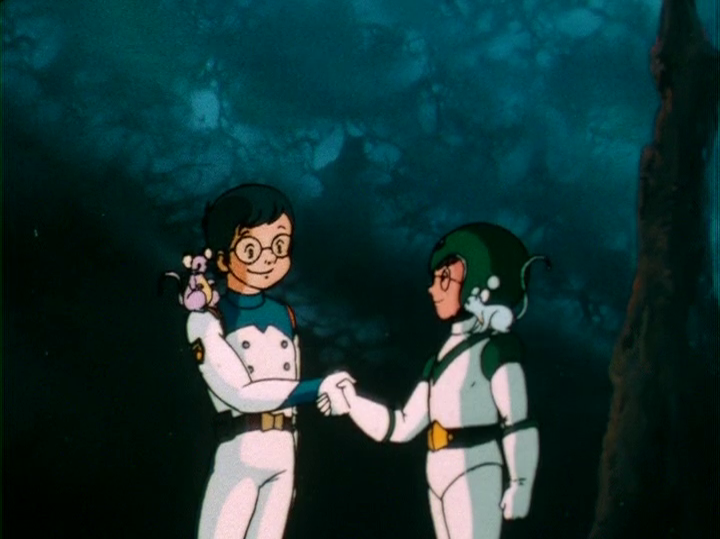
The twins finally re-unite in “Fleet of Doom.” We see them smiling and shaking hands, and a Space Mouse sits on a shoulder of each brother. Chip is taller than Pidge, and they don’t look exactly alike, which suggests that they are fraternal rather than identical twins.
After the events of “Fleet of Doom,” I imagine that Pidge showed his brother some of the Space Mice’s talents, which he had mentioned in his first letter to Pidge in “Letters from Home.”
PIDGE (voice over – as if reading his own letter to Chip): When we’re not flying, I spend my time training animals. You oughta see the great act I’m putting together with some very clever mice here at the Castle.
As an additional curiosity, in “A Ghost and Four Keys,” Pidge calls himself an “Earth man.”
PIDGE: Come on, you robots! You’re only a bunch of nuts and bolts! Let’s see what you can do against one little Earth man!
Why would Pidge call himself an “Earth man?” Before joining the Voltron Force, the brothers had lived on Balto. Did they live on Earth before they were adopted? Were they born on Earth? Did Pidge call himself an “Earth man” simply because he had attended the Space Academy of the Galaxy Alliance, which was headquartered on Earth? Voltron: The Third Dimension establishes Pidge to be a native of Balto, and Voltron Force establishes the same for Pidge and Chip, but that’s not necessarily true in Voltron: Defender of the Universe.
August 23, 2019, Update: I recently noticed a voiceover line of Pidge from the episode “The Little Prince.” The Voltron Force, trapped on the Omega Comet, is on its way to oblivion. A mysterious angel appears before them and offers to them the opportunity to proceed to the afterlife, sacrificing Arus to Lotor, or to return to Arus, sacrificing this opportunity to see what lies beyond. Pidge considers the alternatives:
PIDGE: Maybe I’d see my family again. No, we’ve gotta go back to Arus!
It’s unclear whether Pidge is referring to his biological parents or his adoptive parents. In “Pidge’s Home Planet,” Pidge mentions that he needs to find out where his presumably adoptive family has gone following the devastation of Balto. Maybe he subsequently learned that his adoptive family did not survive.
Pidge and Chip overcame major obstacles in their younger years, they lost their home planet, and they continue to struggle with feelings of abandonment and insecurity. But they are every bit as heroic as their bigger teammates in the Voltron Force.